Introduction. New York does not give you the skyline. You take it. This is Air Rights. You start with twenty-four million dollars. Two firms across the table. Three moves, every quarter. Buy the address that changes the block. Make the income work. Hold your nerve when the market turns. Finish ahead of both of them. A tie is not a win. The first keys are waiting.
Opens Canal Works in deal review. A new campaign asks you to choose a length first. A saved campaign opens your own market, which can differ from this Market 42 sheet.
Fictional asset. These figures are the game’s own Quarter 1 calculation for market code 42. They are not a valuation, a solicitation, or New York zoning advice.
A special edition devoted to property, power and play
Vol. INo. 1
The New York Ledger
The city remembers
Air RightsSpecial
New York, Thursday, October 8, 2026
The city is yours. If you can hold it.
Twenty-four million dollars. Two rival firms. Three moves a quarter. Inside AIR RIGHTS, where buying the building is only the beginning.
The prize above the table. Original AI-generated AIR RIGHTS artwork imagines the city as an architectural model: magnificent, finite, and open to negotiation.
The property deskA feature on Richard LeClezio’s AIR RIGHTS
A fortune is not a strategy
New York — The capital is waiting. The skyline is not. In AIR RIGHTS, a player arrives with $24 million and a deceptively simple ambition: turn a collection of buildings into a winning property business before two rival firms do the same.
The first temptation is to buy something impressive. The first useful question is what it will earn. Behind each address sit rents, expenses, debt and decisions that survive long after the excitement of a successful bid.
There are three actions in a quarter. Spend them pursuing a property and something else must wait: a lease, an improvement, a negotiation. Time is scarce even when money is plentiful. Closing the quarter brings the bill.
The acquisition desk makes that tension explicit. Offers are sealed. Due diligence can reveal the rival ceiling. Winning the auction secures the building; it does not prove that the price was wise.
Your rival has a price
Sterling and Harbor are more than names beside a score. Their holdings can become the subject of purchase offers, counteroffers, sales discussions and property exchanges. Negotiation gives the player another route through a city where the most useful asset may already belong to somebody else.
Even timing becomes a bargaining instrument. A private acquisition can close immediately or at quarter-end. A purchase option can secure a future strike price, but the premium leaves your cash today and the right eventually expires.
The more interesting contest begins when a rival can help. A qualifying city intervention may attract rival sponsorship because the work improves that firm’s buildings too. Competition becomes a calculation: can you create enough value for both sides while keeping the advantage?
That is the game’s sharpest idea. The opponent across the table can also be the partner who makes the next move possible.
The skyline keeps the score
The campaign does not end with a larger number and an empty map. Winning unlocks the next chapter. Ownership and leases reset, but physical changes to the city can endure: conversions, retrofits, additions and completed interventions.
The demands grow. The second chapter adds an income requirement. The third calls for new interventions. The fourth asks for a rival-sponsored intervention and completed development. Earlier work can shape the setting without satisfying a fresh mandate.
Victory is therefore specific. Meet the equity target. Finish strictly ahead of both rival firms. Stay solvent. In later chapters, deliver the additional work. An attractive portfolio alone is not enough.
AIR RIGHTS turns the familiar fantasy of owning New York into a more demanding proposition: deciding what to own, what to improve, whom to deal with and when to stop bidding. The city can be yours. Holding it is the business.
An original newspaper-style feature, not independent press coverage. All game assets, firms and prices are fictional. Based on the current AIR RIGHTS game and rules. No real-world investment claims.
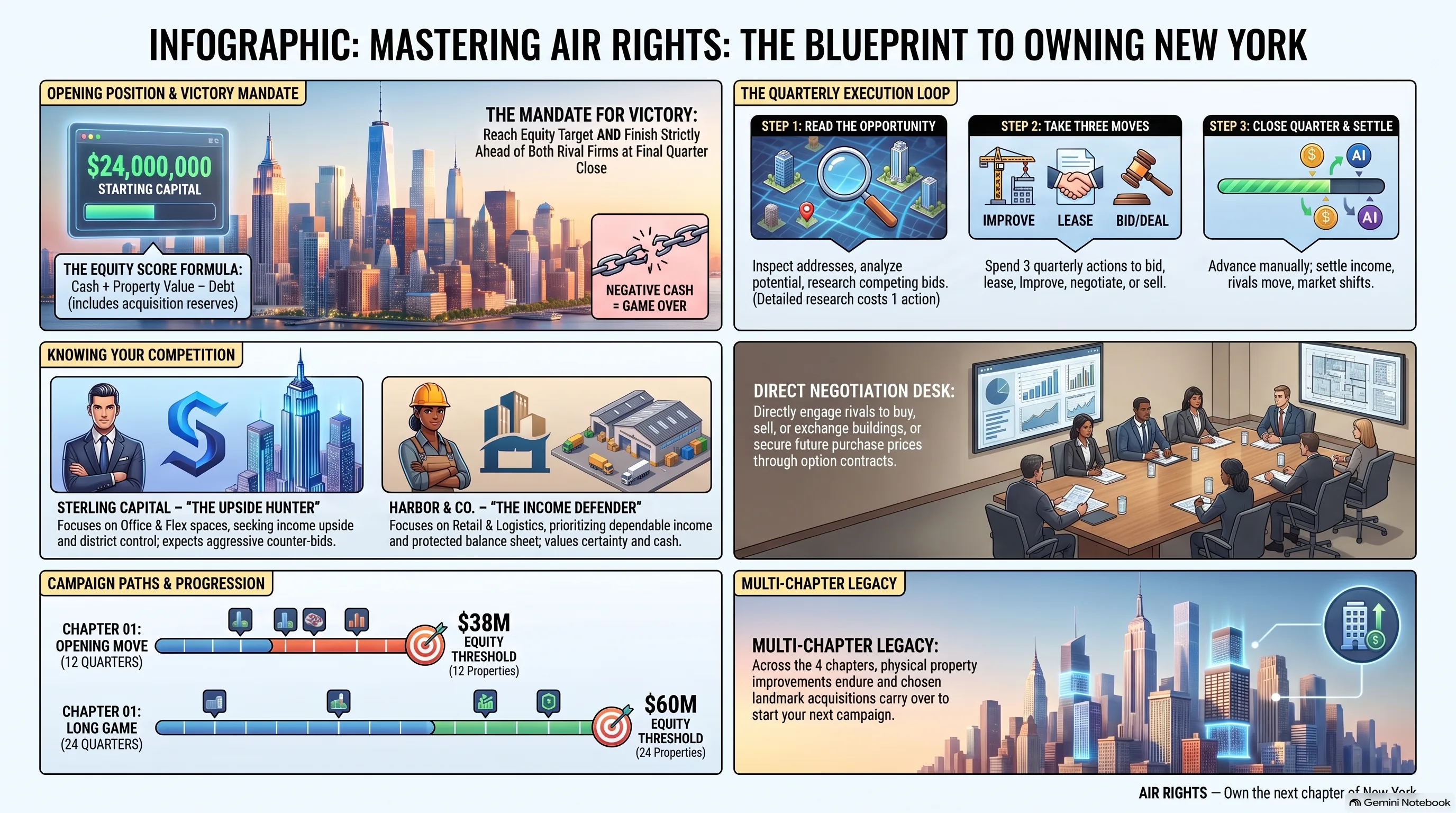
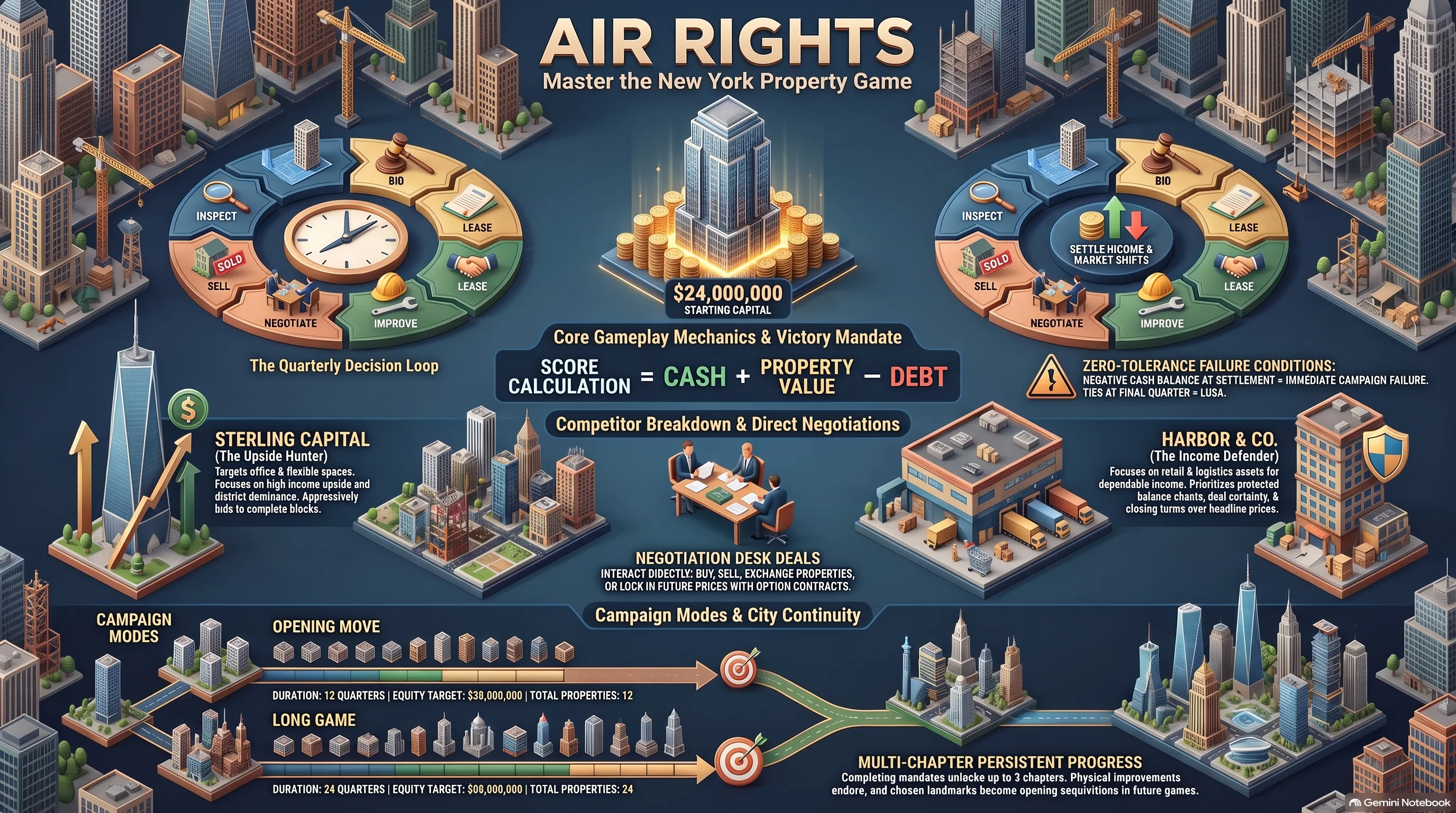
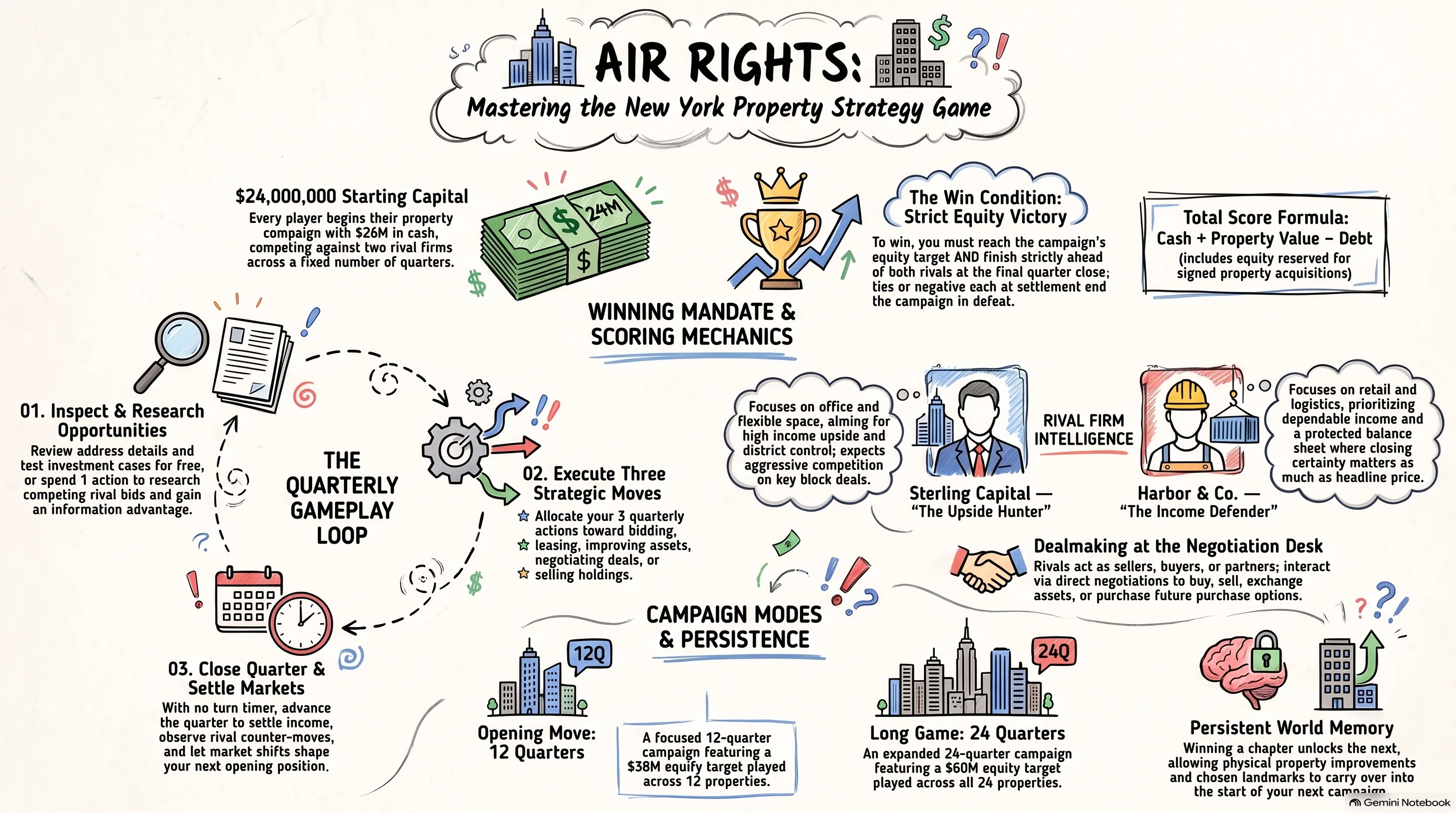
01 / THE GAME
A skyline is built one decision at a time.
You run a property firm in a fictional New York market. The buildings are your assets. Cash keeps you alive. Equity decides who wins.
THE MANDATEFinish ahead.
Reach your campaign’s equity target and beat both rival firms at the final quarter close. A tie does not win. Running out of cash ends the campaign.
Your scoreCash + property value − debtIncludes equity reserved for signed acquisitions.
01
Read the opportunity.
Inspect an address. Test its investment case. Research the competing bid. Information is a decision advantage.
REVIEW FREELY · RESEARCH COSTS AN ACTION02
Make three moves.
Bid, lease, improve, negotiate or sell. Choose what earns an action and what can wait until next quarter.
THREE ACTIONS · REAL CAMPAIGN CAPITAL03
Close. See the consequences.
Income settles. Rivals make their moves. The market shifts. Your new position becomes the next opportunity.
NO TIMER · YOU ADVANCE THE QUARTER
02 / THE MOVE BEYOND THE PRICE
One address. Three different futures.
Follow Canal Works through a scripted opening. Select a move to see its effect on the same building’s economics.
A REAL GAME CALCULATION
Market 42 · Q1 · 45% acquisition debt. This preview uses winning bids just above the rival ceiling. It does not change your saved campaign.
CANAL WORKS / DOWNTOWNACQUIRED
THE OPENING ACQUISITION
The keys are yours.
1 / 3 actions used
Building value$6.08M
Annual NOI$0.44M
Available cash$20.35M
A $6.40M winning bid uses $3.65M cash, including 2% closing costs. Paying above the current game valuation means income and execution have work to do.
THE TRADE-OFFOwning an address is the beginning of the investment.
03 / ACROSS THE TABLE
The other side has a strategy, too.
Rivals bid against you, sign tenants and improve their holdings. They can also become your seller, buyer or investment partner.
SC
THE UPSIDE HUNTER
Sterling Capital.
Office and flexible space. Income upside. District control. Expect a determined counterparty when your building completes their block.
Their preference
Office & flex
Your opening
Bring them an asset they need.
H.
THE INCOME DEFENDER
Harbor & Co.
Retail and logistics. Dependable income. A protected balance sheet. Cash and closing terms can matter as much as the headline price.
Their preference
Retail & logistics
Your opening
Make the certainty worth something.
Everything has a price. Some things have better terms. Buy, sell, exchange buildings or lock a future purchase price with an option.
Win to unlock the next chapter. Physical improvements endure. A chosen landmark can become the opening acquisition of your next campaign.
01
CHAPTER 01 / AVAILABLE FROM THE START
The first keys.
Learn to control capital. Choose a concentrated 12-quarter campaign or a 24-quarter game across all 24 properties. Both begin with $24M and a guided first deal.
The mandate, the quarterly loop, the rivals, and both campaigns. The game screens remain the rules. These sheets are the map.
01 / The blueprint02 / The board03 / The working sketch
BEFORE YOU TAKE THE KEYS
Know the ground rules.
How do I actually win?
At the final quarter close, meet your campaign’s equity target and finish strictly ahead of both rival firms. Later chapters add objectives such as income, city interventions or completed development. Your Mandate screen tracks every requirement. Negative cash at settlement ends the campaign.
How do I interact with the rivals?
Open Negotiations and choose Sterling or Harbor. Buy their buildings, request an offer for yours, propose an exchange or buy a purchase option. Rivals usually acquire their first buildings at the Q2 close. You compete against their sealed bids from the opening quarter.
Can I stop and come back?
Yes. Time advances only when you close a quarter. The game saves to this browser on this device. Returning through Play resumes an existing campaign. Clearing browser data removes the save; campaigns do not sync between devices.
Is this based on real New York deals?
It is a fictional strategy game inspired by commercial real estate. Properties, prices, firms and market events are invented. Development rules simplify the game and do not represent actual NYC zoning or investment advice.